Two ways to be invisible.
Write a sentence any competitor could write, and buyers cannot tell you apart. Write it into a page no crawler can read, and answer engines never repeat it. Both failures produce the same silence. This audit measures both in one pass, on your site and against your competitors, and tells you which one you have.
$2,500 fixed fee. Five business days. One call to walk through the verdict.
Read a real one first. Sample audit, client and competitive set redacted.
Observations
150
Engines
3
Scored sections
30
Rank reported
Never
The problem
The answer arrives before you do.
A buyer asks an engine for the best vendor in your category. The answer names four companies and moves on. You are missing, or you are present and the sentence describing you fits three of the others.
Failure one
The adoptable claim
Cover your logo and read your homepage. If a direct competitor could paste that sentence onto their own site and it stays true, the sentence does no work. It gives a buyer no reason to shortlist you and gives a retrieval system no basis for selecting you out of the set.
Most B2B homepages fail this on the first line. The differentiated sentence usually exists further down the page, under an interchangeable headline.
Failure two
The page a machine cannot read
The retrieval crawlers behind ChatGPT, Claude and Perplexity fetch JavaScript files and never execute them. If your primary claim appears after hydration, sits inside a hero image, or breaks into fragments that need the paragraph above them, it does not exist to the engines.
A defensible claim no crawler can reach is worth the same as no claim at all.
What it costs
Silence costs more than it did two years ago.
8%
Users clicked a search result on 8% of visits to Google pages carrying an AI summary, against 15% where no summary appeared. One percent clicked a link inside the summary itself.
Pew Research Center, July 2025. 900 US adults, 68,879 searches tracked.
2.2x
Brands cited inside the AI Overview earned 2.07% organic click-through on those queries. Brands left out earned 0.94% on the same queries.
Seer Interactive, April 2026. 53 brands, 5.47M queries, 2.43B organic impressions.
45%
Of B2B buyers used generative AI in a recent purchase, and 69% then asked a sales rep to validate what it told them. The engine does not buy anything. It writes the shortlist, and your reps only get to argue with a list they were already on.
Gartner, May 2026. 645 B2B buyers.
84%
Of citations in AI answers point at earned media rather than the brand’s own pages. Your website is rarely the source the engine quotes. It is the source that decides whether the engine can identify you at all.
Muck Rack, May 2026. 25M+ links across ChatGPT, Claude and Gemini. Muck Rack sells PR software.
Why you have not found this yourself
The dashboards report a number that moves when you refresh it.
Ask the same engine the same question a hundred times and the odds that any two answers name the same list of brands run under one in a hundred. Matching order runs closer to one in a thousand. Rand Fishkin’s verdict on tools that sell you a position: “full of baloney.”
SparkToro, 2025. 2,961 responses, 600 volunteers, 12 controlled prompts.
Run one prompt through ChatGPT three times and 2.2% of the citations survive all three runs. Kevin Indig, Search Engine Land, 2026.
A rank that changes every time you press the button is a sample someone sold you as a measurement.
You do not have a ranking problem. You have a presence problem and a readability problem. They have different causes, different fixes and different owners, and a single score hides both.
Buying a visibility tool moves the question rather than answering it. The tools disagree with each other, none publish confidence intervals, and most run prompts nobody actually types. A fixed prompt set you can read, rerun and check yourself costs less and survives an argument.
The audit, part one
Score every claim twice.
I take each positioning claim off your homepage and product pages, collect the actual homepage sentences your competitors use, and score your claims against theirs. No paraphrase. Your sentences and their sentences, quoted side by side.
Claim one: could a direct competitor publish this sentence unchanged without it becoming false? Adoptable, contested, or defensible.
Claim two: can a machine retrieve it? A complete sentence, carrying your entity name, stated as fact, in text a crawler reaches without running JavaScript.
The cross of the two columns is the finding, and every quadrant has a different prescription.
Defensible + retrievable
Your asset. The report names it and says to put more weight on it.
Defensible + unreadable
The cheapest fix in the report. Often under an hour of work on one template.
Adoptable + retrievable
Machines read you clearly and you are saying nothing. More content will not help.
Adoptable + unreadable
Fixing the site alone changes nothing. The positioning has to move first.
The report also names the open ground: claims that zero competitors in your set make. That list is usually the thing a company already owns and does not know it owns. Then it checks whether any of that language reaches your page title, your meta description or your Open Graph card. It almost never does.
The audit, part two
Ask the engines, the same way, every time.
- Ten prompts. Four category-level, three problem-level, two comparison, one brand-level. Nine of the ten never contain your company name, because asking an engine whether a named company is good guarantees a mention and measures nothing.
- One prompt written in your own positioning language. Your claim, turned into the question a buyer would ask. When an engine answers it with four other companies, you wrote the sentence and somebody else is the answer to it.
- Five runs per prompt per engine. ChatGPT, Google AI Mode, Perplexity. One hundred and fifty observations, every one a fresh conversation.
- Every run logged out, with memory and personalization off. No account behind the number, no personalization inside it, and you can reproduce any run yourself in a browser.
- Scott King reports presence as a count out of five, per prompt, per engine. Never a rank. Never one blended percentage. The model label gets recorded at every run, so a model change later shows up as a confound rather than as your decline.
- The prompts go in the report verbatim, and they never change again. A better prompt set next quarter produces a number that cannot be compared to this one.
Running alongside it, the machine read
Retrieval crawlers separated from training crawlers in your robots.txt, because blocking training is a business decision and blocking retrieval is a defect. Snippet directives, because a nosnippet or max-snippet setting stops Google’s AI surfaces from quoting a page they are allowed to crawl. A user-agent parity check against your live site: status, bytes, visible characters and whether your primary claim survives, per bot. Your primary claim tested against the raw HTML, plus whether the links that reach it are real anchors a crawler can follow. Crawl hygiene, including soft 404s that answer 200 and make every dead URL on the site look valid, canonical tags, and whether your key pages are indexed at all. Entity markup and whether your name is identical across your site, LinkedIn and Crunchbase. Passage structure on your key pages. A count of assets an engine could lift and attribute, and whether your images are your own or stock.
Brand
- 1. Name and logo
- 2. Palette
- 3. Typography
- 4. CTA phrases
- 5. Official entity name
Voice
- 6. Tone
- 7. Grammar constraints
- 8. Pacing
- 9. Banned words
Positioning
- 10. Current frame
- 11. Manifesto
- 12. Pillars
- 13. Named traps
- 14. Headline stats with sources
Capabilities
- 15. What we do
- 16. What we do not do
- 17. Link targets
Buyer
- 18. Tier one hypothesis
- 19. Fit matrix
- 20. Channel economics
Retrievability
- 21. Retrieval crawler access
- 22. Server-rendered claim
- 23. Crawl hygiene, including canonical tags
- 24. Entity markup
- 25. Passage structure
- 26. Citable assets
Presence
- 27. Entity resolution
- 28. Third-party citation sources
- 29. Fact consistency
- 30. Prompt presence baseline
Thirty sections get scored the same way for every client. Readiness is the arithmetic over a fixed denominator, shown in the report. A moving denominator makes the percentage meaningless, so the list never changes between clients or between your first audit and your re-measure.
What lands in your inbox
A document you can forward to someone who was not on the call.
Read one before you buy one. The sample is a real audit with the client and the competitive set removed. Twenty-two pages, readiness 60 percent, two unprompted mentions across 91 observations, and a recommended tier with every modifier that produced it shown in full.
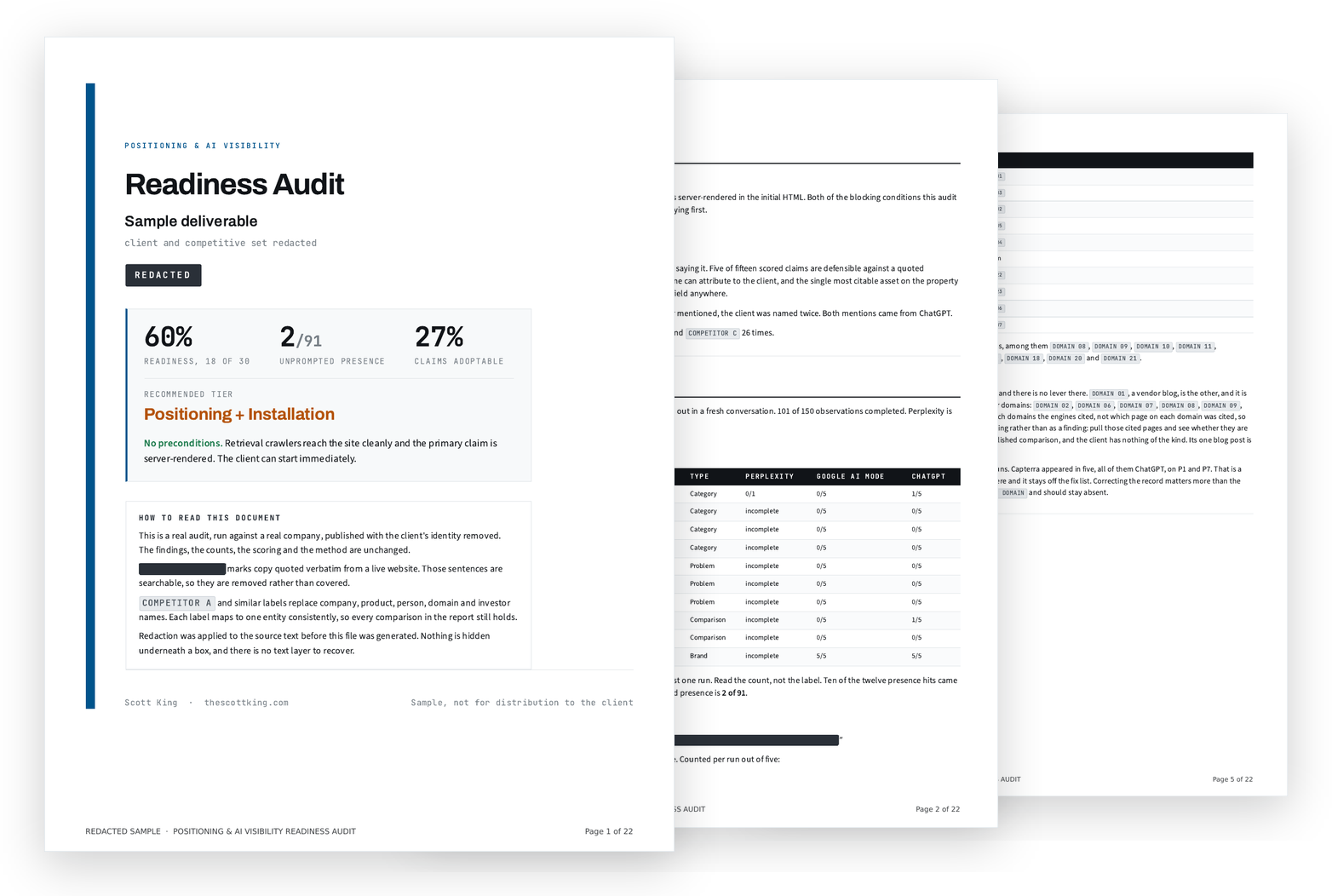
Nothing in it was rewritten for the web. The findings, the counts, the scoring and the method note are what the client received. Redaction was applied to the source before the file was built, so there is no text layer hiding under a black box.
- The verdict first, in plain language, with the preconditions that have to clear before anything else starts.
- Adoptability scoring, your sentences and your competitors’ quoted in full, with the share of your claims a competitor could adopt.
- The crawler table: bot, robots directive, status, bytes, claim present.
- Presence counts per prompt per engine, the competitors named in your place with counts, and the domains those answers were built from. That domain list is your work order.
- A gap list and a fix list, kept separate. They have different owners and different timelines, and running them together stalls the fixes behind a decision.
- A voice measurement taken from your own posts: sentence length, passive constructions per thousand words, overused words with frequencies, and byline concentration.
- Your baseline file, saved, so the ninety-day re-measure compares like with like.
- A method note stating what was read, on what date, under what protocol, which checks ran indirectly, and what this audit cannot tell you.
The refusal list
What this audit will never recommend.
Every item here gets tested and fails. The market sells them as a checklist. Refusing them in writing is how you can tell the difference.
- llms.txt. No major engine requests it. Server logs show the fetches never happen. If you already published one, the money is spent and the answer is to stop spending more.
- FAQPage or HowTo schema “for AI.” Rich results for both are dead and no evidence connects either to citation.
- Blocking Google-Extended to leave AI Overviews. It stops Google from using your pages to train Gemini and to ground answers in Gemini Apps and Vertex AI. It does not take you out of Google Search or AI Overviews, which retrieve from the live Googlebot index.
- Bing rank as a ChatGPT proxy. OpenAI runs its own index. Bing indexation is hygiene, not a KPI.
- More reviews on G2 or Capterra as a visibility lever. A complete, current, correctly categorized profile is an eligibility gate. Volume past that explains almost none of the variance, and in some categories neither site appears in the answers at all.
- Buying a visibility tool. A fixed prompt set and a saved baseline cost less and hold up better.
One rule covers every recommendation the report does make: it states the organic cost. Rewriting a page title that currently ranks for a narrower category can win AI citations and lose search traffic in the same week. Single-channel reporting cannot see that trade, so the report names it in the same sentence as the fix.
What I will not claim
Getting cited is a shortlist you are missing, not a bigger channel than search.
Peer-reviewed work published in Marketing Science in April 2026, covering 973 e-commerce sites and 50,251 referred transactions, found organic search referrals convert about 13% better than ChatGPT referrals. Traffic from answer engines is smaller and, on that evidence, not automatically better once it arrives.
The case for this work sits elsewhere. Buyers now build the shortlist inside the engine and bring it to your sales team already formed. Missing that list costs you the meeting, and no amount of pipeline reporting will show you a deal you were never in.
This audit also has a boundary it does not cross. Server logs, GA4, Search Console and your ad accounts stay out of it. Everything in the report comes from public sources, which means you can hand it to anyone and they can check it. The private data is where the installation starts, not the audit.
Fit
Who should buy this, and who should not.
Buy it if
- You sell B2B software or technology services and your category filled up with near-identical messaging in the last two years.
- You can reach whoever controls the website and the CDN. That person is usually external and almost never the person buying the audit.
- You are about to spend real money on content, paid, or a rebrand, and you want to know first whether the claim is worth amplifying.
- A founder writes most of the company’s public words and nobody has written down how.
Skip it if
- You want a rank number for a dashboard. This audit does not produce one and will tell you why.
- You want the report to agree with positioning that is already approved. It scores what is published, not what was intended.
- Nobody on your side can decide anything about the messaging for the next quarter. The gaps that matter most need a decision, not more research.
If the audit finds your positioning holds, your site reads cleanly, and the engines already name you, the report says you do not need the engagement. That has happened, and saying it is worth more than a case study.
Price and sequence
One fee, one verdict, then your choice.
$2,500 fixed. Five business days. One sixty-minute call to walk the verdict and the fix list. You get the report, the baseline file, and the working drafts behind it.
The audit ends with a recommended tier, and the recommendation is honest about which one the evidence supports.
$7,500
Core Installation
Positioning holds. The kit gets documented and filled from what already exists.
– Custom Branded Claude Plugin
– 90-day re-measure
$15,000
Team Installation
Positioning holds but lives in one head or gets applied inconsistently. Capturing it is the work.
– Custom Branded Claude Plugin
– 90-day re-measure
– Brand Kit
– Messaging Pillar Kit
$30,000
Positioning Rebuild
Most claims are adoptable, or the frame does not match what you actually sell. The argument gets rebuilt first.
– Custom Branded Claude Plugin
– 90-day re-measure
– Brand Kit
– Messaging Pillar Kit
– ICP Framing
The ninety-day re-measure
Ship the fixes, then I run the same ten prompts, the same five runs, the same three engines and the same thirty sections. The report shows what moved, what did not, and the honest reason. Movement that follows a dated fix is your case study. Movement with nothing shipped gets labeled as noise, and movement across an engine’s model change gets reported as unattributable rather than sold back to you as progress.
Questions
Before you book.
What does one of these reports look like?
Read one. The sample audit is a real run with the client and the competitive set removed. Twenty-two pages: the verdict, the adoptability scoring with sentences quoted, the crawler table, presence counts per prompt per engine, the domains those answers were built from, the gap list, the fix list, the tier with its modifiers, and the method note.
It is also the run where an engine hit its quota. Perplexity completed 1 observation of 50, so the report ships with that engine marked incomplete and its 49 missing runs are not estimated, averaged or extrapolated anywhere in the document. Every count in it rests on the 101 observations that finished, and says so. A cleaner sample would have been easier to publish and would have told you less about how the work gets done.
Ten prompts sounds small. Why not a thousand?
Volume is not the constraint. Repetition and comparability are. Five runs of one prompt tell you more about whether an engine reliably names you than one run each of five prompts, and a set small enough to publish in the report is a set you can rerun yourself.
The ten come from your category’s language and your own claims, written before the first run and frozen afterward. Tools that generate hundreds of prompts get precision on questions nobody types.
Everything runs logged out. Real buyers are logged in.
True, and it is the trade I make on purpose. A logged-in session carries account history and personalization, which means the number describes one person’s engine rather than yours. Logged out has no memory behind it, so the measurement is reproducible by you, by your CMO, and by me in ninety days. The report says this plainly in the method note rather than hiding it.
Can you just tell me where we rank in ChatGPT?
No, and nobody else can either. Ask any vendor selling you a rank how many times they ran the prompt and what the spread was across runs. The answer decides whether you are buying a measurement or a screenshot.
Do you need access to our analytics or ad accounts?
No. The audit runs on public sources only, and the report says so. When a finding needs private data, it gets marked with the role that holds it rather than filled with a guess.
We already know our positioning is weak. Why pay to hear it again?
Then the useful part is the rest: which specific claims a competitor could adopt word for word, which of your good sentences a machine cannot reach, which competitors the engines name in your place, and which domains those answers were built from. That last list tells you where to spend, and most companies have never seen it.
What if the report finds nothing wrong?
It says so and recommends no engagement. A readiness score above 70% with no strategic gaps and no defects means you are running fine without me.
Find out what the engines say about you.
A report you can hand to your CMO, your agency, and whoever owns your website.
$2,500 fixed
Sources
Figures on this page are quoted with their sample and date so you can check them. Where a study was published by a company with a stake in the result, the page says so.
- Pew Research Center, “Google users are less likely to click on links when an AI summary appears in the results,” 22 July 2025. pewresearch.org
- Seer Interactive, “AIO Impact on Google CTR: 2026 Update,” 24 April 2026. seerinteractive.com
- Gartner, “Gartner Survey Finds 69% of B2B Buyers Turn to Sales Reps to Validate AI-Generated Insights,” 20 May 2026. gartner.com
- Muck Rack, “What Is AI Reading?” May 2026 edition. muckrack.com
- SparkToro, “New Research: AIs Are Highly Inconsistent When Recommending Brands or Products.” sparktoro.com
- Kevin Indig, “How to make prompt tracking more accurate,” Search Engine Land. searchengineland.com
- Vercel, “The rise of the AI crawler,” 17 December 2024. vercel.com
- Kaiser and Schulze, “ChatGPT Referrals to E-Commerce Websites,” Marketing Science, 21 April 2026. informs.org